
For all dental requirements, many families choose a single facility. Preventive and restorative dental care are common in Geelong. Orthodontic solutions are also offered by several clinics. Invisalign and braces may aid with bite function and smile alignment.
Age and dental requirements determine the best course of action. During your appointment for family dental care in Geelong, a family dentist may discuss appropriate solutions. Families may plan better dental care and keep their teeth healthy for years by being aware of the options that are available.
Which Orthodontic Procedures Are Offered by Family Dental Care?
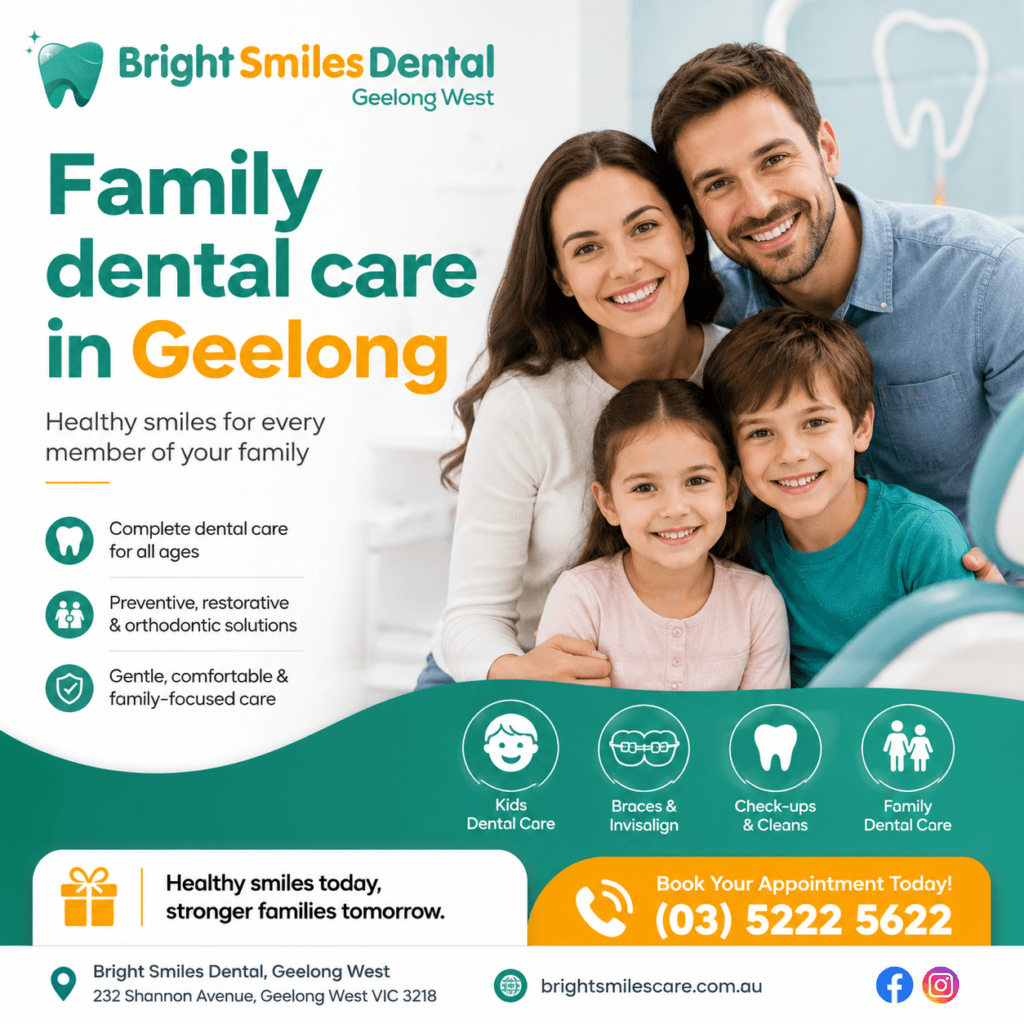
Orthodontic treatment can address several alignment and bite problems that affect your smile and oral function. At Geelong West Bright Smiles Dental, treatment options can include traditional braces and clear aligners, depending on your dental needs.
Braces for Kids’ Developing Smiles
As kids develop, traditional braces may help realign their teeth. For crowded teeth, spacing issues, or specific biting issues, they could be advised. Additionally, early evaluation enables dentists to track the growth of teeth and jaws.
The dental growth of each kid is the basis for treatment programs. Frequent visits make it easier to track tooth mobility and make necessary corrections. As permanent teeth erupt, this strategy may promote better alignment.
Adults and Teens Using Invisalign
Traditional braces may be discreetly replaced with clear aligners. With Invisalign, teeth are progressively moved into predetermined locations using a set of custom-made aligners. When eating, drinking, brushing, or flossing, the aligners may be taken out.
Numerous alignment issues may be resolved with Invisalign. Crowded teeth, gaps, overbites, underbites, crossbites, and open bites are some of these. Before proposing clear aligners, your dentist will examine your teeth and bite. Your smiling objectives and the intricacy of your situation will determine the course of therapy.
Handling Congested Teeth
When there is insufficient room for teeth to align correctly, crowding occurs. Teeth may twist, overlap, or seem misaligned. Brushing and flossing may become more challenging as a result.
Better alignment may be progressively achieved with orthodontic treatment. Depending on the patient’s requirements, braces or clear aligners may be used. Additionally, better tooth placement might facilitate everyday dental hygiene.
Fixing Overbites
When the upper front teeth protrude too much over the lower teeth, an overbite develops. While a little overlap may be acceptable, a large overbite may need an orthodontic evaluation.
In appropriate situations, braces or clear aligners may assist in correcting tooth placement. The goal of treatment is to improve the connection between the upper and lower teeth.
Handling Underbites
When the lower front teeth are positioned forward of the upper front teeth, this is known as an underbite. When you bite, this may have an impact on how your teeth connect.
In some situations, orthodontic therapy may aid in correcting tooth placement. Before suggesting therapy, the dentist will examine the bite and surrounding tissues.
Fixing Crossbites
When the mouth closes, some upper teeth fall within the lower teeth, resulting in a crossbite. It may impact one or more teeth.
Affected teeth may be guided into better positions with the use of orthodontic therapy. For younger patients whose jaws and teeth are still growing, early evaluation may be very helpful.
Dealing with Open Bites
When the mouth closes, parts of the top and lower teeth may not connect, resulting in an open bite. Biting and other daily activities may be impacted by this.
The alignment of teeth and the way they fit together may be improved with orthodontic treatment. The source and severity of the issue determine the best course of action.
Filling Up Unwanted Gaps
Another typical reason individuals think about orthodontic treatment is the spaces between their teeth. While some gaps may result from dental position or missing teeth, others may occur spontaneously.
By progressively bringing teeth closer together, braces and clear aligners may fill up certain gaps. Before suggesting therapy, your dentist will ascertain the cause of the void.
Retainers Following Orthodontic Therapy
When your teeth are positioned as intended, orthodontic therapy is not over. Following braces or aligner therapy, teeth may naturally move.
Retainers aid in preserving the outcomes attained after therapy. How and when to wear your retainer will be explained by your dentist. Over time, adhering to these guidelines might help safeguard your new alignment.
The goal is not simply to make teeth look straighter. Orthodontic treatment can also improve alignment, bite function, oral hygiene, and long-term dental health.
Why Is Receiving Orthodontic Treatment from a Single Family Dental Clinic Beneficial?
Simpler Maintenance for Each Family Member
Managing appointments is made simpler with a single dental practice. Visits may be planned jointly with parents. Adults and children are cared for in one location. This lessens stress and saves travel time.
Dentists are aware of the dental history of every member of the family. They are better at organising treatments. For family dental care in Geelong, you may get regular and orthodontic treatment at a single, reliable location with family dental care. This makes the whole therapy process go more smoothly.
What Should You Know Before Beginning Invisalign or Braces?
Your Smile Requires a Comprehensive Evaluation
A thorough examination is the first step in any orthodontic treatment. Your dentist examines the alignment of your jaw, teeth, and gums. Digital scans or X-rays might also be beneficial. The optimal course of therapy is revealed by these evaluations. Braces are beneficial for some people.
Others could be eligible for Invisalign. A thorough assessment avoids needless medical intervention. Before making a choice, individuals receiving family dental treatment in Geelong are assisted in understanding all of their options.
Avoiding Certain Foods May Be Necessary
Braces may be harmed by certain foods. Popcorn, sticky foods, and hard candies increase the danger. Foods that are softer are often safer options. Before eating, Invisalign users should take off their aligners.
It is generally okay to drink water while using aligners. The meals that need special attention are explained by your dentist. Practical guidance to safeguard your daily treatment is part of family dental care in Geelong.
In conclusion
Children, teens, and adults may all benefit from braces and Invisalign. Your objectives and smile will determine which choice is best for you. Every step of therapy is made simpler with professional advice. Frequent examinations also promote long-lasting outcomes.
Families of all ages may get individualized orthodontic treatment from Geelong West Bright Smiles Dental. Discuss appropriate treatment choices with skilled doctors and dentists in Geelong to experience a healthier, more self-assured grin.